Showing posts with label devine. Show all posts

Sunday, 23 November 2014

The role of a critic

I am a tadpole when it comes to the wine industry, going quietly but energetically about my business and learning every step of the way. An industry that is full of very big bullfrogs that croak loudly every chance they get. The wine critic/judge/journalist is a vital cog in the world wine machine, guiding and educating a 'relatively' ignorant public on what they should be drinking and why, and taking the emphasis away from clever names and pretty labels. Their word should be taken with a pinch of salt because the most important thing about wine is knowing what you like. Every palate is different and while getting insight into the impressions of an expert palate is important, it is even more vital to concentrate on training and listening to your own palate.

One of South Africa's very own big bullfrogs, with an encyclopedic wine knowledge, has given me his take on the subject.  He prefers to remain anonymous. 

In a democratic society everyone has the right to express an opinion thanks to the fundamental right of freedom of speech. Under a totalitarian regime this expression can land one in jail or worse. So thankfully, a bona fide critic can freely express an opinion, but exactly who is qualified and what role does a critic play in society......... Firstly to be a critic, one should know what he is talking about, in other words be intellectually schooled and have practical experience of the subject involved. To be a theatre critic one has to have expert knowledge of plays, poetry, stage craft and literature etc. and have first hand knowledge of what he/she is writing about. However the verb criticise implies an element of finding fault, it is submitted that this is not the primary function of a true critic but critics may be criticised and agree to disagree and leave it to the reader to choose which opinion to follow. 

So exactly what role does a critic play? In short he or she helps to shape public opinion. One does not necessarily have to agree with the opinion but should be the wiser as a result of having read or heard of the critic's view. To be a journalist, writing say on wine, one has to have a detailed knowledge of all aspects of the subject and be honest in his or her view and be able to defend it. South Africa, being a major producer of wine, has a number of respected wine critics who occasionally graduate to become judges of the quality of wines at international and local wine shows. A critic usually comes to the notice of the public via articles published in the press, magazines or the internet and they develop a following. If you're wondering what impact a critic can have on the wine industry, the answer is tremendous. An example of this is the remarkable following Robert Parker has in the United States and other parts of the world. If he gives a wine a rating over 90 points, the price reacts accordingly. Here at home the Platter wine ratings certainly influence the public. This leads to the question of how to assess the integrity of the critic. 

This is a difficult issue and can only be answered by examining the credentials of the critic (both academic and practical) and the consistency of his/her views and whether or not they are generally accepted by their peers. Thus far the wine industry has had no scandal relating to wine critics and those who do not have the required level of competency are soon found out and quietly disappear. 

Another guide is the awards earned by the critic, such as a Master of Wine, as well as international recognition by way of being appointed as a judge at international events. The prestige of the publisher of articles also shows a level of success, but the ultimate recognition comes from the industry itself. The Champagne House of Louis Roederer annually awards a prize to the wine writer of that year which reflects how the industry values the views of the critic. 

It is pointless listing all of our wine writers but mention must be made of Dave Hughes, Phyllis Hands, Christian Eedes, Tim James, Christine Rudman and Michael Fridjhon who have all had distinguished careers. However of all of these one really stands out as an international authority. 

Michael Fridjhon has been writing about wine for The Business Day, The World of Fine Wine, The International Herald Tribune, Decanter, and been a contributor to The Oxford Companion to Wine and has been a taster for the Platter wine guide for a number of years. He has judged numerous wine competitions, such as the Six Nations Challenge, the Australian National Wine Show and the International Wine Challenge (2007). He also runs the prestigious Old Mutual Trophy Wine Show and has written the Penguin Book of South African Wine. In addition he has received peer recognition as a recipient of the French Chevalier de L'Ordre du Merit Agricole, an honorary life member of the UK circle of wine writers, an honorary life member of the South African wine tasting society, the Cape Wine Academy person of the year and visiting professor of wine business at the University of Cape Town. 

Fridjhon co-authored a book entitled 'Conspiracy of Giants' which led to his role in advising and assisting the Minister of Agriculture in the dismantling of the KWV statutory powers in 1998. 

With an example like that the future of top class wine journalism should be assured. So to be a successful critic his/her judgement should generally be accepted over a period of time as setting a benchmark standard for successors to emulate.

A final word - a critical opinion should be constructive not destructive.  
 

Elgin - the apple of my eye


Travelling up the Highland's Pass, from the South, is in my opinion, the intelligent way to visit this region. First stop is Iona and here you'll not only get a taste of what makes the place special, you'll also get a great birds-eye view of the wonderful bowl of mounds and hollows that, along with it's soils, it's elevation, cool climate and sea breezes, give this place the ability to control the vine, optimising potential through the slow ripening of fruit and putting more concentrated and complex flavours in the glass. Once prime apple and pear territory, there has been a revolution over the last 25 years and now some very special wines are being produced.

 
Our 1 day visit saw us stopping at Iona, Southhill, Charles Fox, Oneiric, Highlands Road, Paul Wallace, Hannay and Catherine Marshall Wines and Belfield. The astonishing thing was the hospitality of the people, with owners and winemakers sitting pouring wine for us, overlooking their vineyards. The sort of 'hands-on' attitude that is (wonderfully) becoming more commonplace in South Africa. What people like myself (that make the effort to travel into different wine regions) are looking for is a genuine feeling of the people and passion of the place, that's all. Maybe a little wine as well.
Iona's entrance
 
Mind the fountain

The view from Charles Fox
 
On the way in to Oneiric


Highlands Road

Kosie van Der Merwe - 'sleeping' winemaker at Hannay
 
Mike Kreft - always a gem
 
I was truly impressed with my first visit to a region (MAP) that has pretty rapidly risen to the top of my SA wine destination list. The crisp, terroir-driven wines of Iona, Paul Wallace's 'Big Dog' Malbec and even bigger sense of humour and the elegant reds and open arms of Mike Kreft at Belfield, there was a surprise around every corner. My wine highlights were was follows:

2009 Iona One Man Band - a big, elegant blend of Syrah, Cab, Merlot, Petit Verdot and Mouvedre

2012 Oneiric Chardonnay - a great balance of wood and fruit with a long, lingering finish

2010 Oneiric Cousin Jack - an elegant 50/50 Cab/Merlot

2013 Highlands Road Sauvignon Blanc - fig/gooseberry/mineral in droves

2014 Paul Wallace Little Flirt (Sauvignon Blanc) - my number 1 value for money pick

2011 Elgin Vintners Chardonnay - with such big fruit, the french oak serves only to elevate this wine, and the result is pure balance and intense complexity

2011 Elgin Vintners Viognier - try this even if you don't like the varietal, beautifully wooded with a long finish

2010 Paul Wallace Black Dog Malbec - fruit bomb of note

2011 Hannay Cabernet Franc - lively fruit, low in tannins

2010 Belfield Syrah - 'The grapes were harvested at 23.5 balling, in the cool of the morning, and soaked on the skins for four days at 12ºC for optimal flavour and colour extraction. The wine was fermented dry on the skins, then racked to French oak barrels for malolactic fermentation. Maturation took place in barrel for 11 months.' - this is the wine that you just have to try!


Wednesday, 10 September 2014

Ataraxia, The Plettenberg and the taxi that forgot about us

I have been fortunate enough to attend a few wine dinners at 'The Plettenberg' over the last few years.  It's a great place to enjoy a meal and to learn about and taste some of our fantastic South African wines.  The exciting thing is that it seems as if these events are getting better and better.  A recent dinner, with wines from Ataraxia, was almost perfect.  I'll let the menu do the talking:

 
Canapés
Confit duck wonton

Smoked salmon tartar

Broccoli, pear & Danish feta quiche

Ataraxia Sauvignon Blanc 2014
 

Free range chicken ballottine

baby gem, parmesan custard, anchovy aioli,

pancetta crisps, caramelised walnuts

Ataraxia Sauvignon Blanc 2014
 

Slow roasted pork belly

prawn and glass noodle salad, spiced pineapple chutney,

asian vinaigrette, crackling

Ataraxia Chardonnay 2013
 

Parmesan gnocchi

oyster mushrooms, baby beets, deep fried artichokes,

 red onion marmalade,pine nut paste

Ataraxia declassified Pinot Noir 2013


Roast beef tenderloin

oxtail, potato & wild mushroom gratin, pea puree, confit pearl onions,

 red wine jus

Ataraxia Serenity 2009


assiette of friandise

Earl grey madeleine, assorted macaroons, pistachio & walnut baklava, marshmallows, Turkish delights, mini tiramisu phyllo baskets


Executive chef, Grant Parker, had the somewhat difficult task of compiling a menu that could stand up to a list of wines of exceptional quality.  The food could very easily have been bullied into the background but this was not the case.  The food and wine shone in equal measures. 

Kevin Grant, owner and winemaker at Ataraxia, has a special piece of land in the Hemel-en-Aarde Ridge Ward, near Hermanus.  He's a self-proclaimed soil farmer and says that essentially what he does is put soil in a glass, with the help of some grapes and a bit of effort.  Kevin, a Burgundy fanatic, is working hard to create wines that have ageing potential.  A great example of this is his Chardonay, with a delicate oak expression that accentuates the complex fruit and bold mineral acidity.  In fact, an ABC (anything but Chardonnay) advocate at our table, who, when first presented with the wine, nervously sniffed and poked at it, fell in love and it turned out to be her wine of the night.  In reference to his Sauvignon Blanc, Kevin says the vintage on the label shouldn't be the sell (or consume) by date, sadly an impression that is often absorbed by the market.  He is a winemaker that speaks with abundant humour and a chiseled common sense and I can't remember experiencing a more interesting, informal wine talk in the last few years.  The 'declassifed' 2013 Pinot Noir, that is not being commercialised until it's just right (according to Kevin), has huge potential and seems to, like his Chardonnay, be a cheerful amalgamation of old and new-world winemaking and style.

The most wonderful thing about the evening was that we had pre-booked a taxi for the ride home.  The worst thing was it never arrived.

Grant has very kindly given me the recipe for his Gnocchi dish.


parmesan gnocchi

oyster mushroom, baby beets, deep fried artichokes,

red onion marmalade, pine nut paste


for the parmesan gnocchi
  1. 400g potato
  2. 160g white flour
  3. 1 whole egg
  4. 5ml fine salt
  5. 120g finely grated parmesan cheese
Method:
  • bake the potato in an oven at 180 degrees for approximately 40 mins making sure it's cooked all the way through
  • peel the potato and pass it through a fine sieve
  • add the flour, egg, salt and parmesan
  • knead the mixture for 5 mins
  • lightly dust a board with flour and break the dough into 4 pieces
  • roll the dough into a sausage shape, approximately 1.5cm in diameter
  • from the left hand side cut the end piece off and discard
  • pinch the mixture with your index finger and thumb to form a hour glass shape and cut on the right side of the shape, will be about 2cm in length
  • cut all the dough and place on a tray, lightly dusted with flour, use a large knife to pick this mixture up
  • place a pot on the stove with water and salt and bring to the boil
  • have a container with ice and cold water ready
  • in batches place the gnocchi into the boiling water and stir softly so that it doesn't stick to the bottom of the pan
  • once the gnocchi comes to the surface it is cooked, with a slotted spoon remove it from the water and place into the ice cold water
  • carry on this way until all the dough has been cooked
  • strain the gnocchi, place it into a container and sprinkle with olive oil, which will make sure it does not stick together

for the red onion marmelade
  1. 1 red onion, chopped fine
  2. 30ml unsalted butter
  3. 30ml brown sugar
  4. 20ml balsamic vinegar
  5. 30ml red wine
  6. salt and freshly ground black pepper
Method:
  • melt the butter in a saucepan
  • add the onion and sauté until tender and slightly brown
  • add the brown sugar and cook until it is dissolved
  • add the balsamic vinegar and red wine
  • reduce the heat and simmer until the liquid has evaporated, then remove from the heat

for the pine nut paste
  1. 100g pine nuts, toasted with olive oil and maldon sea salt
  2. 20ml olive oil
  3. blend the nuts in a food processor, slowly adding the oil until the mixture becomes smooth

for the baby beets
  1. place the beetroot in a pot, cover with cold water and add salt
  2. cook the beetroot until tender
  3. peel and cut in to match sticks

for the deep-fried artichoke hearts
  1. from a tin of artichokes, peel the leaves off and dry as much as possible
  2. lightly dust with corn flour and deep fry until golden brown
  3. place on a paper towel and season with salt

putting the dish together
  1. put a black pan on the stove, moderate heat and add a drizzle of olive oil
  2. pan fry the gnocchi until golden brown, remove and place in a container
  3. pan fry the oyster mushrooms and season with salt and chopped thyme (once almost cooked)
  4. add 125ml white wine and reduce by half, then add 125ml fresh cream and simmer
  5. add your gnocchi and red onion marmalade
  6. place the gnocchi into a soup plate
  7. spoon the pine nut paste with a teaspoon into the centre of the dish on top of the gnocchi
  8. sprinkle the beetroot around the plate
  9. add your artichoke and shaved parmesan
  10. sprinkle the top of the dish with chopped chives
Enjoy with a glass or 2 of pinot noir!
                      

Saturday, 23 August 2014

Stealth Delheim visit


Delheim was the first ever wine estate I had the pleasure of visiting.  This was quite a long time ago and I remember running around like a little hooligan.  That's probably because at that stage I was a little hooligan.  With the passing of time and the associated wisdom that is (hopefully) inevitable, I decided that, on my recent visit to the estate, I needed a well executed covert operation.  You never know, they may well have had a 'wanted' picture of me in reception.  I negotiated my way through the vineyards and into the tasting room and quietly went about my business.  What I can tell you, if you can keep a secret, is that their Gewurztraminer and Pinotage, as well as a few other things, are very good. 

Delheim has wine pairings with cakes and pancakes, and have evenings that involve cheese fondues and jazz.  Worth a visit I would say.  Where else can you have your cake and a glass of wine too.    


Vriesenhof


I recently enjoyed some of the Vriesenhof and Paradyskloof wines in the tasting room at their very picturesque vineyards.  Impressive views and wine indeed.  In celebration of 30 years of their Paradyskloof wines they have released the 2011 Paradyskloof Pinot Noir/Cinsaut/Pinotage blend (the father, mother and child).  A really interesting, easy-drinking, relatively light red that would work a treat chilled at a warm, summer lunch. 

Their 2008 Vriesenhof Pinotage was my favourite but all of their wines are well made. 


Tuesday, 19 August 2014

Esona - the very (good) one

The husband and wife owned wine estate of Esona is serenely perched on the banks of the Breede River, between Robertson and Bonnievale.  All of the grapes on the farm are hand-picked and end up in their 'Frankly my dear' Pinot Noir Blanc de Noir, and their 3 single vineyard wines, the Chardonnay, the Sauvignon Blanc and the Shiraz. 

A little while ago I was lucky enough to attend the Friday night event at Esona during the Slow Festival. Seventeen guests started with an atmospheric vertical tasting in their old, underground, candlelit kuip (20,000 litre cement tank) that not only gave us an appreciation of their vintage variation but also the importance of having wine in glasses that are designed to show them off.  We then moved upstairs and enjoyed a 3 course, home-cooked meal with their superb wines.  Owners Rowan and Caryl were our hosts for the evening and when I say they got pretty hands-on that's exactly what I mean.  Caryl prepared all the food and Rowan was MC, waiter and reserve dish-washer.  The whole team that took care of us on the evening did a great job but Heinrich, who has a special talent when it comes to looking after guests, deserves special mention.  A truly unique experience at one of South Africa's great boutique estates.
Rowan and Caryl

The springbok loin (the main) was so good that I got hold of Caryl and asked her for the recipe.  Here it is:


Caryl's springbok loin   

Ingredients:
  1. a good sized springbok loin, cut into steaks
  2. a pack of streaky bacon
  3. oil
  4. 1 small onion, chopped
  5. a squeeze of lemon juice
  6. 1/2 to 1 cup of red wine (preferably Esona)
  7. 2 Tbsp Worcestershire sauce
  8. some herbs, whatever you like
  9. a good sprinkling of black pepper
  10. 250ml cream
  11. 1 Tbsp chicken stock
  12. a few cloves of garlic, crushed
Method:
  • quickly sear each steak in hot oil and set aside to cool
  • retain pan juices
  • when the meat has cooled a little, wrap each piece in 2 strips of bacon
  • place on a foil-lined baking dish, shiny side up
  • just before you are ready to eat put the tray of meat in a 180 C oven, and cook for 5 minutes each side, no longer if you're wanting it rare (as it should be)
  • use the pan that you could the meat in (with juices left)
  • brown the onion, add lemon juice, the red wine, the Worcestershire sauce and the herbs
  • add a good sprinkle of black pepper, a little garlic, some chicken stock and allow to reduce and thicken
  • you can add a little corn flour to help with the thickening
  • before serving add the cream and heat through, don't let it boil at this stage
  • enjoy with mash, rice or cous-cous and some vegetables    

Friday, 18 July 2014

A kiss of Pinot Noir

Pinot Noir (PN) is an extremely difficult, somewhat temperamental varietal to handle.  She (for some reason the feminine seems to fit) is a bit like the incredibly demanding, slightly fragile kid at the back of the classroom, difficult to train and even harder to manage - the teacher's nightmare.  An educator, when presented with one of these testing little creatures, has a choice to make.  Give up and let the child do what it wants until you happily wave them goodbye at the end of the year or try as hard as possible to see their potential (which may be well camouflaged), nurture and encourage it, and watch it become something beautiful.  A lot of retired teachers will look back at their school days and talk about their favourite students, a lot that were initially those absolute nightmares.  This challenge is similar to what a winemaker and viticulturist face when they look out over their PN block. And I think that's why a lot of them love making the stuff.  As they say in the classics, with great risk comes great reward. 

PN, from the French for Pine (because of the varietal's tightly clustered growth) and Black (for fairly self-explanatory reasons), is most famous in Burgundy, and the Champagne region uses it's fair share in their magical bubbles, usually alongside Chardonnay and Pinot Meunier.  New Zealand's South Island, Oregon and California in the States, Tasmania and the Yarra Valley in Oz and various parts of South Africa have more recently been recognised as potential PN areas, and are now making some fantastic wine. 

It's a varietal that does not have a thick skin (pun intended) and is not only vulnerable to wind and frost but also needs to be very well cared for because of it's tightly clustered bunches.  But it is this sensitivity that makes this particular grape so special.  When well handled and protected it becomes the very embodiment of elegance and has the ability to show off even subtle differences in soil type, making it a wonderful advocate of terroir. 

One must always remember that even though some describe it as being 'sex in a glass' or 'the most romantic of wines', the true essence of PN is that it cannot be tamed.  In my (humble) opinion, drinking a glass of PN is like experiencing a kiss.  Early on in the process, you'll know if it's a good or a bad one, and there will always be that specific one that will be benchmark for all others to come. 

I got to experience my benchmark kiss PN a while back at Newton Johnson (NJ), in the Upper Hemel-en-Aarde Valley, near Hermanus (in South Africa's Western Cape).  As I mentioned above it's a varietal that expresses itself very differently in various soil types and NJ is a great example of this.  I was luckily enough to taste PN from all of their blocks, some not far apart on the farm (literally only a few meters separating them), but amazingly different in the glass.  Their Family Vineyards PN is their blend of the blocks; giving the particular character and complexity that they (and I) are after.  A while back I mentioned the restaurant at NJ which is an added extra that makes any visit to the estate seriously worthwhile.      


Last night I decided to enjoy a bottle of NJ's Family Vineyards PN and cooked up a little roasted mushroom mix that worked an absolute treat.


Roast mushrooms with sour cream and crushed pecan nuts

Ingredients:
  1. 2 punnets of mushrooms, some exotic, some ordinary
  2. a handful of thyme, leaves removed, stalks discarded
  3. a handful of flat leaf parsley, roughly chopped
  4. 1 tsp chopped fresh garlic
  5. 1 tsp chopped green chilli
  6. a glug of olive oil
  7. a few knobs of butter
  8. a couple of pecan nuts, crushed
  9. sour cream
  10. salt and pepper to taste
Method:
  • heat oven to 180 C
  • to a baking dish, add mushrooms, herbs, garlic, chilli, olive oil, butter and a bit of salt and pepper
  • put in the oven for about 15 minutes, or until done
  • remove and serve, with a dollop of sour cream and a good sprinkling of nuts
  • I served the mushrooms with some chilli and ginger calamari steaks but they could go with anything
  • they go especially well with the PN 

Thursday, 10 July 2014

Paul Cluver Wines


The farm has been in the family since 1896 and the current wine business is still very much a family affair.  I had a wonderful tasting of a selection of their wines the other night and was also given their secret recipe.  Well, not so secret.  Here it is:

Ingredients:
  1. a dollop of intelligence
  2. a few spoonfuls of forward thinking
  3. a handful of science
  4. a gallon of hard work
  5. some varied slopes, soils and exposures
  6. a little higher altitude and southerly position to taste 
  7. a generous sprinkling of cooling summer sea breezes   
Method:
  • mix all of your ingredients well, watching the slow ripening of the grapes and the resulting complexity in the glass
You must be mad if you've never tasted a Paul Cluver wine.  They are the bona fide representation of Elgin terroir and a wonderful example of what is happening in a South African wine industry that is flexing it's muscles.

Jacqueline Harris, from Paul Cluver, has given me an easy recipe to go with their very good Gewurtztraminer. 


Moroccan lamb ribs

Ingredients:
  1. a rack of lamb ribs, separated (your nice butcher can do this for you if you like)
  2. plenty of good Moroccan spice mix (blend of cumin, coriander, harissa and rose petals)
  3. a braai (barbecue)
Method:
  • rub ribs thoroughly and lovingly with spice
  • make sure the Gewurtztraminer is chilled
  • braai ribs until cooked the way you like them
  • enjoy

Monday, 28 April 2014

Bouchard Finlayson

Peter Finlayson, winemaker at Bouchard Finlayson, is one of the pioneers of the Hemel-en-Aarde valley and a stalwart of the industry in South Africa.  With a strong focus on Pinot Noir in the vineyard, an enthusiasm for Chardonnay, an interesting mix of international varietals (mainly in the unique Hannibal blend) and a wonderful setting, a visit and tasting at this winery is a highlight of any journey into this incredible wine region.

On a recent visit I was suitably impressed and the wine that shone for me was the Limited Edition Kaaimansgat Chardonnay 2010, from grapes sourced from a Villiersdorp farm.  Really well balanced, pretty much exactly what I am looking for in a food chardonnay, with a great combination of tropical fruit and cinnamon apple, a complex wine that is given a real lift with 50% going in new French oak and 50% experiencing no wood at all. 

Peter Finlayson has given me his Bouillabaisse recipe, something he enjoys with his Kaaimansgat Chard.

Bouillabaisse

Ingredients:
  1. a couple of fish heads
  2. a few onions, finely chopped
  3. a knob of butter
  4. salt and pepper
  5. 2 cups of white wine
  6. 4 tomatoes, chopped
  7. 2 tsp Thai curry seasoning
  8. 2 tsp fish Masala
  9. 1 tsp ground fennel seeds
  10. 1 Tbsp apricot jam
  11. 2 bananas, chopped
  12. 1 lemon
  13. 400g fresh white fish
  14. 400g peeled prawns
  15. 300g calamari
Method:
  • boil up fish heads in a pot of water for around an hour, sieve, then set stock aside
  • take a wide, flat-bottomed pot and brown the onions
  • add the white wine and allow to simmer for 10 minutes
  • add the chopped tomato, Thai and Masala seasoning, fennel, apricot jam, bananas, lemon juice and fish stock and allow to simmer for 30 mins
  • season with salt and pepper
  • 5 minutes before serving add fish, prawns and calamari    

Friday, 28 March 2014

Pierre and his Giant Periwinkle

 
The boutique winery of Giant Periwinkle, in Bredasdorp, is making a Fume Blanc, a Sauvignon Blanc, a Pinot Noir and a Syrah. Sadly their impressive Malbec is a thing of the past. I popped in a few weeks ago (at the cellar at Zoetendal) and was lucky enough to meet Pierre Rabie and to taste the reds out of a few Romanian and French barrels. There was a really interesting barrel variation (even with the same grapes and same french oak barrels) and the Syrah was amazingly accessible with great fruit, zingy white pepper and a hint of saltiness. A great example of the cool climate Syrah's this part of the world is capable of. 


Elim - The Beautiful South

Not far from Africa's southernmost point at Cape Agulhas, is the Elim Wine Ward.  An environment that can truly be said to be suited to 'cool climate' wines with frequent sea 'breezes' chilling the vines.  By planting the right thing, in the right soil, with the correct sun and wind exposure, and most importantly not fiddling too much in the cellar, most of the winemakers of this part of South Africa have brought out the absolute best in their grapes.  The slow ripening of the fruit, due to the cool and relatively harsh conditions (and also soils that make the vines work to survive) allow for greater complexity and body in the wines.  This, in my opinion, is best expressed in their Sauvignon Blancs, with flinty minerality, great fruit and a natural acidity. 

The 2013 Strandveld Sauvignon Blanc, taken entirely from the Pofadderbos vineyard, is a wine that captures the uniqueness of the terroir perfectly.  Besides puffadders, the vineyard also has ferricrete soils and this plays a big part in creating the intense complexity, concentration and balance of powerful minerality and lively tropical fruit.  Their Adamastor is a very well constructed (Bordeaux) blend of Sauvignon and Semillon from South Africa's southernmost vineyards.  It's a fairly intense wine that requires a bit of concentration and is great with food.  

Strandveld's very talented winemaker, Conrad Vlok, is a great example of the young force that is taking South Africa's wine image to new heights.  His obvious passion for the industry is evident in all of his wines and even though his awards and medals could fill his cellar, he is about as down to earth as you get.

He's been incredibly busy in his vineyards of late but has still found time to give me a recipe that he feels works well with the Adamastor. 


Conrad's fresh Cob (normally caught off his kayak) with Sycadelic Sauce

Ingredients:
  1. some fresh cob, filleted with the skin left on
  2. a little flour
  3. a handful of fresh coriander
  4. a wedge of butter
  5. half a lemon
Sycadelic Sauce:
  1. 2 Tbsp canola oil
  2. a handful of crushed cashew nuts
  3. 1 chopped red chilli, seeds removed
  4. 2 cloves fresh crushed garlic
  5. 100ml lemon juice
  6. 2 Tbsp fish sauce
  7. 3 Tsbp apricot jam
Method:
  • cut the fish into portions, dust with flour and set aside
  • heat the oil in a small pot and fry the cashews, chilli and garlic for a few mins
  • add the lemon juice and simmer for 2 mins
  • add the fish sauce and simmer for another 2 mins, then stir in the apricot jam
  • cook slowly to glaze
  • taste the sauce, it should be a good sweet/sour combination (adjust if needed)
  • fry the fish portions in a pan with a little oil, meat side first until golden
  • turn the heat down and turn the fish skin side down
  • as the skin starts to turn brown add the butter and squeeze in the fresh lemon
  • don't overcook the fish
  • put a good scoop of sauce over the top of each of the fish portions and garnish with some fresh coriander
  • serve from the pan
  • enjoy with some basmati rice, sweet potato and most importantly a chilled bottle of Adamastor
    

Tuesday, 17 December 2013

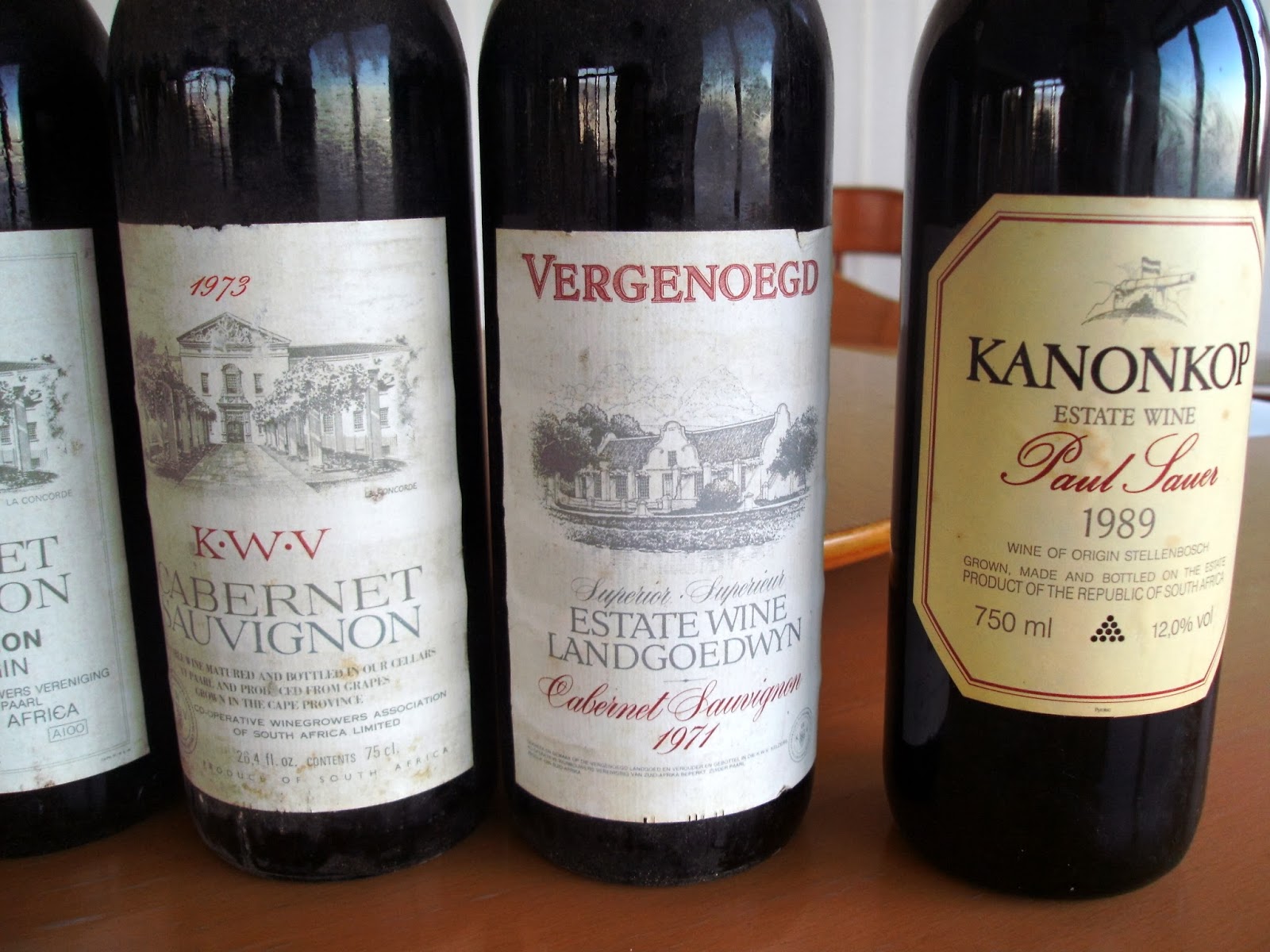
A few more Old South African Wines


Some more old stuff, all of which had been well cellared and were in relatively good condition.
  1. 1970 (something) KWV Cinsaut
  2. 1980 Landskroon Pinot Noir
  3. 1973 Alto Rouge Estate
  4. 1975 KWV Roodeberg
  5. 1978 KWV Cabernet Sauvignon
  6. 1973 KWV Cabernet Sauvignon
  7. 1971 Vergenoegd Cabernet Sauvignon
  8. 1989 Kanonkop Paul Sauer
I particularly enjoyed the Landskroon, the Kanonkop, the '78 KWV Cab but the stand out on the night for me was the '71 Vergenoegd that was very much alive, with rich blackcurrant and a luscious lingering finish.

Saturday, 26 October 2013

Naughty cork

This little collection of relatively old South African wines provided a few surprises, some absolute (and probably expected) shockers and a huge amount of conversation.  The risk with cellaring wines is that by the time you surgically extricate pop the cork, the wine may have already crested it's particular 'hill', free-wheeled rapidly down the other side and settled into the harsh, but ultimately guaranteed, oblivion of vinegar and nothingness.

The wines tasted were:
  1. Nederburg Cabernet 1970
  2. Zonnebloem Cabernet 1970
  3. Backsberg Cabernet 1980
  4. Zonnebloem Merlot 1997
  5. Laborie Estate Blend 1980
  6. HC Collisen Cabernet 1983
  7. Backsberg Pinotage 1987
  8. Rustenberg Pinot Noir 1982
  9. Fairview Shiraz 1980
  10. Rust en Vrede Tinta Barocca 1987
  11. Glen Carlou Le Trois 1997
  12. Drostdy Hof Merlot 1998
  13. Fairview Cabernet 1979
  14. Bertrams Zinfandel 1980 (?)
  15. Bertrams Shiraz 1980 (?)
  16. Alto Estate Blend 1994
The 1987 Backsberg Pinotage was deep purple, full of fruit, well balanced and quite a surprise to the 12 tasters.

The Bertrams Zinfandel (from the early 80's) was complex with a lovely lingering finish.

The 1983 HC Collisen was the most impressive Cabernet, with lively blackcurrant.

The 1998 Drostdy Hof Merlot was possibly the most enjoyable, easy-drinking, uncomplicated and still quite young.

The 1982 Rustenberg Pinot Noir was highly drinkable with a great earthy nose and elegant fruit on the palate.

Lessons learned:
  1. Wines, including Cab's, don't always get better with age.
  2. Corks can be stubborn.
  3. Too much wine = headache.
 

Monday, 30 September 2013

Kranskop Wine Estate - just a skip and hop from Robertson

 
I had a bottle of Kranskop a few years ago and remember it being a pleasant enough experience. More recently I attended a wine dinner at a Robertson restaurant (during the Slow Festival) and was treated once again to a taste of Kranskop.  Wine-maker Newald Marais has been in and around the industry for some time and after experiencing this dinner and also tasting a few of his other wines my ears perked up big time.  There's some special wines coming out of this cellar.
 
At the recent Michaelangelo awards they got gold for their 2012 Chardonnay and silver for their 2012 Viognier.  At the Terrior Wine Awards the 2012 Viognier and 2011 Noble Late Harvest bagged them 2 national awards and their Pinot Noir 2011 a regional award.  The 2012 Viognier also achieved a bronze at the Old Mutual Trophy Wine Show.  A great achievement!

The Noble Late Harvest is the one I've got my eye on - a sexy little number that is serious at the same time.           

Saturday, 17 August 2013

Old things are more beautiful?

Old things are more beautiful
than many things brand new
because they bring fond memories
of things we used to do.
Old photographs in albums
love letters tied with lace
recapture those old feelings
that new ones can't replace.
Baby shoes, a teddy bear,
a ring that Grandma wore,
are treasures waiting there behind
a door marked "Nevermore".
Old things are more beautiful,
more precious day by day.
Because they are the flowers
we planted yesterday.
 
Author - Clay Harrison


Certainly old when it comes to South African wine, possibly dead, but definitely a gamble I'm willing to take. 


Friday, 16 August 2013

De Wetshof's way with Chardonnay


One of my many pre-booked activities for the recent Robertson Slow Festival was the Mystery Chardonnay tasting at De Wetshof.  This was my first visit to the estate and on driving up towards the beautifully impressive tasting room I wondered why.  These guys are one of the few 3rd generation operations in South Africa and have a reputation for producing exceptional Chard's.

Johann De Wet opened the huge solid doors for us and we entered a reception room that was warmed gingerly by a wood-fire and generously by a hospitality that you'd expect at a mates home.  We learnt about the variety of soils on the farm, from clay to rock, and how this is uniquely expressed through the wine.  We learnt about the importance of cellaring, enhancing the natural characteristics of the grapes but not being too pushy with wood.  Most of all we learnt about the families passion for their land and how it comes to life in each and every bottle.

I was blown away with the whole thing and that was before I encountered the 1993 Finesse. Eish!

Tuesday, 23 July 2013

IPA you beautiful thing

A little while ago I attended the Knysna Craft Beer project which showcased a few of the smaller, specialised, GREAT South African breweries and a huge range of styles of the wonderful liquid.  In my younger days I enjoyed a beer or 2, lured by pricing and the lifestyle and image promoted by certain gigantic beer companies.  These uncomplicated, weak and chemically enhanced beer examples were just what the doctor ordered for my pathetic teenage palate.  Something to fill a gap and to 'lighten the mood'.  With age and the wisdom (?) that followed I have been drawn to the grape and beer is something I now only occasionally indulge in.  When I do I want something with a bit of backbone; a strong brew that offers real and pure malt flavours.  The Indian Pale Ale (IPA) is an example of just this and has a style that has attracted me for quite a while.  Boston Breweries, in Cape Town, makes a great IPA, and this was the definite winner for me at the Knysna Festival.

IPA has a controversial and interesting history.  One train of thought is that it was originally created, with it's increased hop and alcohol content, to make sure it didn't spoil on it's journey to the British troops in India.  Another was that the increased hops was a vital component of beer to be consumed in the warmer climates.  Back in the day beers were dark and murky things.  With better understanding and control of the malting process brewers were able to produce a more pale variety and this was something different for the consumer.  Add higher hop levels, the notion that it was a beer that should be drunk in warmer conditions and give it a name like Indian Pale Ale and you've got a winner.  Whatever it's history, it's certainly a beer that has a future.             

Sunday, 30 June 2013

Is wine good for you?

I recently stumbled upon a copy of a Wynboer (Wine Farming) magazine from 1979 which provided some fascinating reading. It was an issue specifically looking at Wine and Health, with numerous articles on the subject.

'Wine is the best medicine', a book published by a medical practitioner named Dr Maury, talks about the tremendously high success rates he's achieved through medicating his patients with high quality wine. 

Illness French Daily dosage
Allergies Medoc 1 glass
Diarrhoea Young Beaujolais 4 glasses
Fever Dry Champagne 1 bottle
Gout Sancerre or Pouilly-Fume 4 glasses
Menopause St. Emilion 4 glasses
Nervous depression Medoc Red 4 glasses
Weight loss Cote de Beaune 4 glasses
Weakness of the liver Dry Champagne 4 glasses

I find the Gout treatment regime of particular interest.

The work of an American researcher named Bogen, from 1933, equating levels of blood alcohol to behaviour is summarised in the table below:

Alcohol per 100ml blood Behaviour
0.03mg dull and dignified
0.05mg dashing and debonair
0.10mg dangerous and devilish
0.3mg disgusting and disorientated
0.4mg delirious and dishevelled
0.5mg drunk
0.6mg dead drunk
0.7mg dead