Tuesday, 15 November 2011

The Whale Trail


The De Hoop Nature Reserve, located about 60km south of Swellendam in the Western Cape, has got to be one of most beautiful in the country. And that’s saying something! SA has a lot of very good ones.

I recently joined friends and family and took on a journey through the area using the recommended vehicle, ones feet. The Whale Trail is a 60km hike that takes you from hut to hut on a roughly circular route through the picture perfect landscape of the park. The accommodation along the way is not 5 star but is way more comfortable than I expected. There were always hot showers and most had indoor and outdoor braai (BBQ) areas. The kitchen had all the crockery and cutlery you’d need and the bunk beds were fine. The best thing about the walk is the way it’s organised. If you pay a little extra you can have your luggage transported for you, and this comes in very handy when you’re taking cooler boxes and wine. The huts are cleaned every day and at the end of the trail, at Koppie Aleen, there’s a shuttle bus that takes you back to your vehicle at Potberg, where the walk started.

After climbing the Potberg Mountain, first thing on day 1, you meander along a ridge dominated by the colour of fynbos and proteas, with views over the Breede River Valley and the ocean in the distance. By early afternoon on day 2, you finally reach the sea as you drop down into the rocky cove of Noetzie, to what was my favourite overnight stop of the trip. About half an hour later a whale drifted past and greeted us with a couple of fin flaps. Day 3, 4 and 5 are spent making your way back along the beach and rocky coastline and the geographical beauty would under normal circumstances be more than enough to keep one entertained. But The Whale Trail is certainly not normal, and if you get the season right, like we did, you’ll have the added bonus of whale shows the whole way to the end. There are tidal pools to wallow in, beaches to laze on and if you’re of the birding variety you will be in your element.

As I mentioned earlier the fact that you can get your cooler box transported for you on a magic carpet is very convenient. We took wine, braai stuff and plenty of other goodies, way more than we would have been able to take if we were carting it around ourselves. We braaied most evenings and one night, to give us a bit of an energy boost, I made an easy puttanesca.


My easy camping puttanesca

Ingredients:

- a blob of olive oil
- 2 cloves garlic, finely chopped
- chilli seasoning (to taste)
- 2 tsp dried origanum
- 2 packets of black olives
- 2 tins of capers wrapped in anchovies
- salt and pepper
- a packet of pasta
- 2 cans chopped tomatoes

Method:

- heat olive oil, add garlic and spices
- add tomato, olives and caper/anchovy mix
- season
- while this cooks slowly for around 15 mins cook the pasta
- mix all and serve hot with an extra glug of olive oil

I selected this post to be featured on Food Blogs. Please visit the site and vote for my blog!

Saturday, 12 November 2011

Thank God for Creation (Wines)


The Hemel-en-Aarde valley, just inland from Hermanus, has made serious inroads in the South African wine industry. You can’t go wrong with the likes of Newton Johnson, Ataraxia and Bouchard Finlayson but there was only one estate that was going to cheer me up after the generally unfriendly Franschhoek folk. Creation makes great wine and after my recent and first visit to their estate I can tell you that it’s not just their wine that’s good. Their restaurant and tasting room has views over the vineyard and with a menu that offers pies, salads and some great platters, I was a happy boy. But the wines were the main attraction and I was thrilled to find out that you get to taste their entire range. Yes, are you listening Franschhoek, even their premium wines.

They have a new ‘Whale Pod’ label, which includes a white blend and an incredibly good Syrah/Malbec that I predict is not going to be that easy to get hold of fairly soon.

Creation has given me a recipe to enjoy with their Sauvignon Blanc.


Salmon cheese cake

Ingredients:

- 910g cream cheese
- 6 eggs
- 250ml cream
- ½ cup spring onions
- ½ tsp Tabasco sauce
- 1 tsp Worcester sauce
- ¼ tsp paprika
- ¼ cup chopped parsley
- 450g smoked salmon, cut in small cubes

Base:

- 1 cup bread crumbs
- ¾ cup parmesan cheese
- 4 Tbsp melted butter

Vegetable mix:

- 1 cup chopped onions
- ½ cup chopped red peppers
- ½ cup chopped yellow peppers
- 2 Tbsp shallots
- 1 tsp garlic

Method:

- for the base, mix breadcrumbs, parmesan and butter
- line a 30cm glass pie dish with the above mix
- saute the veg mix in olive oil until soft
- allow it to cool on paper to remove moisture
- beat the cream cheese and add eggs, one at a time
- add the cream
- fold in the rest of the ingredients using a spatula
- add the veg mix
- fill up the pie dish with the cake mixture and bake at 180 C for 1½ hrs, until golden and almost set
- remove from oven and allow to cool down
- serve with a crisp green salad and Creation Sauvignon Blanc


Huguenot hospitality - Franschhoek's 2 H's?


I’ve only ever driven through Franschhoek and once or twice sat up on a hill looking down over the town, pondering life and the valley below. If you do some research you’ll discover that the town is one of South Africa’s culinary superstars and when you combine that with a generous scattering of vineyards you’re bound to have some fun. Or so we thought as we decided to spend 2 nights on the outskirts of town. We visited most of the wine estates and had dinner at the highly rated and recommended ‘Le Bon Vivant’ and even though I’d love to report back on just how wonderful everything was, unfortunately that’s not going to happen. I’m not big on complaining and will therefore keep this brief and try to give it a bit of a positive spin.

The town has thoroughly embraced its heritage and in feable economic times, with less opportunity for international travel, given all Southern Africans an easily accessible opportunity to appreciate genuine French hospitality. The wine estates worth a stop are La Bri, Stony Brook, Haute Cabriere and Dieu Donne and Anthonij Rupert's Motor Museum at L’Ormarins is fantastic, even if you’re not a petrol-head.

Scotty's


I am a big fan of well done wine dinners, the sort of occasions that see chefs putting a bit more punch on their plates and winemakers bragging about just how good they really are. I’ve been fortunate enough to attend quite a few in recent times and I don’t think I've ever walked out unhappy.

The latest of these events, a tasting of Morgenhof at Scotty's, in Plettenberg Bay, sits at the top of my scoreboard and will be there for a while. The 5 courses of exquisite fare was flawless; great food cleverly and perfectly paired with good wines. The stand out for me was the marriage of the Merlot with the meat course, a grilled fillet of beef with peppered blackcurrant jus served with a pumpkin puree and parsley mash.

Morgenhof’s wines were very good but struggled to shine on an evening dominated by a very talented kitchen. The wine estate, nestled just outside Stellenbosch on the slopes of the Simonsberg Mountains, is owned by Anne Cointreau, a lady with a family tree that has aged roots in the business of making Cognac and liqueurs. Their Fantail range seems very affordable and even though the Pinotage was by far the most reasonable of the wines tasted, it was, in my opinion, probably the best.

If you ever find yourself in ‘The Garden Route’ make sure you ask around and find Scotty's, you won’t be disappointed. Owner/chef Scott Rattray came second in the Sunday times chef of the year in 2010 and Delvin Reck, who recently joined the team, won 'The Stalwart of the Kitchen' award in this years competition. They certainly don't show off, with food that is unpretentious, interesting and bold at the same time, and there’s something for everyone. Scott has given me his delicious Blackcurrant jus recipe. Give it a try.

Blackcurrant jus

Ingredients:

- 50ml veg oil
- 1 Tbsp butter
- 500g beef trimmings – not fatty
- 1 onion, sliced
- 2 tsp whole black peppercorns
- 6 white mushrooms, sliced
- 1 stick celery, sliced
- 2 cloves garlic, whole
- 1 carrot, peeled and sliced
- 1 tsp salt
- 2 tsp tomato paste
- 2 tsp white flour
- 200ml cassis
- 500ml red wine
- 3 litres chicken or beef stock
- 25g lump of chilled butter
- 2 cups of fresh or frozen blackcurrants

Method:

- heat a large pan, add butter and oil
- add meat trimmings and fry for 20 mins
- add onion, carrot, celery, mushrooms, pepper, garlic and salt
- cook for another 15 mins, until veg has taken colour
- add tomato paste and flour, cook for 5 mins more
- add cassis and cook it off until dry
- add red wine and reduce by half, then add stock
- gently simmer for 30 mins, then strain through a fine sieve
- return to a clean pan and reduce the sauce down to about 600ml
- if you need, thicken with a bit of cornflour
- check seasoning, stir in lump of butter
- just before serving, add the berries, bring back to the boil, skim and then serve

Friday, 21 October 2011

The Ballinderry - more than just a guest house


The Ballinderry is a guest house in the town of Robertson, situated in one of the most fantastic wine valleys of the Western Cape. Somehow Belgian owners Luc and Hilde have managed to create an interior that is both modern and chic but more importantly relaxed and comfortable, quite literally a home away from home. The two of them are very good at what they do and if you’ve never met them have a look at the photograph above. A great picture that I managed to find in the dictionary under ‘hospitality’. They have a passion for what they do and this translates beautifully into all that is around them but most noticeably onto the exciting plates of food that leave Hilde’s ordered and immaculate kitchen. Her breakfasts are exceptional but what takes me back every time I am anywhere near them is the 3 course dinners that seem to get better and better. With the combination of her Belgian heritage, a love for Mediterranean cuisine, her natural palate and some true creative genius, Hilde never disappoints and puts amazing things together.

The menu last Friday was a perfect example of the type of food she likes to cook (and I like to eat).

Starter: Cheese soufflé and salad

Very light Old Amsterdam cheese soufflé, side salad with dried fruits and slow roasted cherry tomatoes.

Main: Duck a l’ Orange, gratin potatoes and veg

Duck leg slow roasted in an orange and port marinade, duck breast pan-fried and flambéed with brandy, gratin potatoes, red cabbage and fried apple and a port orange sauce.

Dessert: White Belgian chocolate icetart, dark chocolate sauce and fresh strawberries.

Yes please!

Hilde has very kindly given me her Cheese soufflé recipe and I’m going to share it with you.

Ballinderry’s Cheese soufflé (for 6)

Ingredients

- 120g Old Amsterdam Cheese, grated
- 20g white flour
- 12g butter (+ extra for the ramekins)
- 300ml hot milk
- 4 fresh jumbo egg whites (or 5 large) – room temperature
- 1 tsp of baking powder
- a few fresh sage leaves, chopped
- black pepper
- salt
- nutmeg
- 6 lightly buttered ramekins

Method

- melt butter in a pan on a low heat and add flour
- use wooden spoon to stir the dry mixture.
- gently pour in the hot milk while whisking firmly, using a hand whisk
- as soon as starts to boil, switch of the heat
- add cheese (keep on whisking) followed by baking powder
- season with sage, salt, pepper and nutmeg
- not too much salt or nutmeg as the cheese is rather salty
- let the mixture cool down a little while you beat the egg whites
- gently fold in the egg whites and pour into the ramekins (3/4 full)
- preheat the oven to 175 C
- put ramekins on a baking tray a bit below the middle
- bake for 12 to 15 minutes
- souffles are ready when their top is golden and centre moist
- do not open the oven while baking.
- serve immediately with a little salad on the side with slow-roasted cherry tomatoes, dried fruits and a drizzle of olive oil.

TIP: You can make the mixture a few hours in advance but without the baking powder and egg whites, which you only add to the mixture (room temperature!) before baking.

Wednesday, 12 October 2011

Weltevrede - a sense of place


The Wine Estate of Weltevrede (or fully satisfied) sits near Bonnievale on the banks of the Breede River. The funnel shaped Robertson Valley, between the mountains of Langeberg and Riviersonderend, channels the flow of air which is cooled by the river and then carried gently across the vineyards. This is exactly what the farmers want and is one of the reasons the region is able to produce such outstanding wine.

The Jonker family has been wandering the farm of Weltevrede since 1912 and the running of the estate now rests on the very capable shoulders of Phillip Jonker. He’s had some experience in both California and Bordeax and has become somewhat of a Chardonnay expert; but the family’s intimate knowledge of the place, passed down through generations, cannot be underestimated. The Jonkers believe that when the earth was created and decorated with soil, water and vegetation, off-cuts of some of the very best bits were taken and joined together to form the patchwork of terroir that surrounds Bonnievale. A good example of this is their ‘Place of Rocks’ and ‘Rusted Soil’ Chardonnays, exactly the same grape but very different wines, both produced on the estate but nurtured on different sides of a little hill.

I’ve just done a tasting with Weltevrede and had the chance to revisit their Rusted Soil Chardonnay, undoubtedly one of my favourites. I also had my first taste of their new Vanilla Chardonnay; something they’re doing in an attempt to attract those who aren’t mad about the varietal. Through specific soil and barrel selection they’ve managed to create something that is crisp and un-wooded, with a lingering hint of vanilla. I think they might be on to something with this one and it’s certainly good value for money. I reckon on a hot day it would go superbly with a salad, maybe something like bacon, prawn and papaya.


Bacon, prawn and papaya salad

Ingredients

- a handful of young leaf spinach
- a good glug of olive oil
- 2 Tbsp lime juice
- 10 bacon rashers
- 1 large papaya, cut into large cubes
- 1 ripe avocado, cut into lengths
- 10 prawns
- 2 tsp cumin
- butter
- salt and pepper

Method

- season prawns with cumin, salt and pepper
- heat butter in a pan and cook the prawns until just done
- mix olive oil and lime juice in a bowl
- grill bacon until crisp and cut each streak in half
- add prawns, bacon, spinach, papaya to the bowl and mix well
- serve with a chilled glass of Vanilla Chardonnay

Saturday, 1 October 2011

Genuine passion, real flavour; Micro-breweries deserve more attention

Micro-breweries face a number of challenges in a market dominated by the copiously advertised and distributed brands that are not short on pocket change. What sets them apart from these beer Goliaths is the fact that they use no preservatives or additives and don’t pasteurize to lengthen shelf-life. Their beers are natural and hand-crafted; with lots of variety and superb quality and flavour.

Living in England for a couple of years, I got the chance to explore the regional real ales but travelling Australia’s East Coast is what really opened my eyes to micro-breweries and their magical liquid produce.

South Africa is relatively new to the micro-brewing scene but hopefully, with the support of discerning beer lovers, they’ll gain popularity and create ripples throughout the marketplace. The general public has begun to be a little more in tune and inquisitive with what they’re consuming, like where and how products are made and the things that are put in them.

I’ve chosen a couple of micro-breweries to highlight, one fairly well known, the other young but certainly making inroads.


Knysna has been the home of Mitchell’s Brewery since 1983, but because of growing demand, the brand has spread countrywide with a branch opening in Cape Town in 1989. They use only local ingredients, in a process that combines German lagering and British mashing techniques, and produce beers that are high in flavour and low in alcohol. They have the Forester’s Lager, the Bosun’s Bitter, the Raven Stout and last but certainly not least the 90 Shilling Ale, a full-bodied traditional Scottish Ale that I encountered only recently for the very first time, but is actually their biggest award winner. It's made from malted barley, yeast, hops, water and cinnamon and the end result is a spicy ale that is big on flavour.

Mitchell’s recommends an Asian Pork Stir-fry with the 90 Shilling and they were kind enough to give me a recipe for exactly that.

Ingredients:

- 300g medium egg noodles, cooked
- Chinese 5 spice
- 700g pork belly, sliced
- 2 tsp sesame oil
- 2 Tbsp sunflower oil
- 2 Tbsp freshly grated ginger
- 2 red chillies, deseeded and chopped fine
- 1 red pepper, deseeded and roughly chopped
- a bunch of spring onions, trimmed and sliced
- 2 cloves garlic, peeled and finely chopped
- 5 carrots, julienned
- a packet of red cabbage, sliced
- a handful of green beans
- 1 Tbsp honey
- 2 Tbsp dark soy sauce
- a bunch of fresh coriander, leaves and stems chopped and separated

Method:

- heat a wok and another smaller pan
- pour oils in the wok and fry ginger,chillies and coriander roots for a minute
- add peppers, spring onions, garlic and veggies and fry until wilted
- add noodles, coriander leaves, honey and soy
- fry for 3 mins until noodles are steaming hot
- at the same time drizzle a little olive oil in a pan
- rub pork with 5 spice and then fry for 2 mins each side
- serve all together with a 90 Shilling


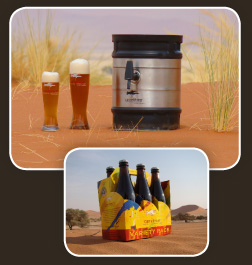
Camelthorn Brewery, the dream and baby of Jorg Finkeldey, was opened in Windhoek in 2009. He, a South African trained chemical engineer, named his brand after an indigenous tree to highlight it’s resilience in challenging environmental conditions. There are 5 different craft beers under their umbrella and occasionally Jorg creates an additional seasonal delight. Their Brauhaus or Weissbier, a Bavarian style wheat beer, is something very special and even better when combined with an Eisbein. Try the recipe below, get yourself a top wheat beer and see what I mean.


Eisbein with sauerkraut and bread dumplings

Ingredients:

- kosher salt
- curing salt
- 1 litre water
- 3 bay leaves
- 1 tsp marjoram
- 2 tsp all spice
- 1tsp black pepper
- 2 tsp bashed coriander seeds
- 1 tsp juniper berries
- 2 carrots finely diced
- 1 onions, finely chopped
- 2 tsp sugar
- 5 garlic cloves, bashed

Method:

- make the brine by mixing 120g of kosher salt and 12g of curing salt per litre of water
- make enough to cover the pork completely
- make sure you chill the water thoroughly before continuing
- put pork in a plastic container and cover with the brine
- leave in the fridge for 4 days
- bring a pot of water to the boil
- rinse the pork under running water and pop in the pot
- bring back to the boil, remove scum from the surface and turn heat to low
- simmer the pork gently for 3 hours

Bread Dumplings

Ingredients:

- 2 stale rolls, torn into cubes
- 1 cup of warm milk
- 3 eggs, beaten
- a handful of fresh parsley, finely chopped
- a pinch of nutmeg
- salt and pepper to taste

Method:

- put the bread in a bowl and knead in the milk lightly
- cover and leave to rest for 30 mins
- mash up the soaked mix to form a thick dough
- mix in eggs one at a time
- add the rest of the ingredients and knead until smooth
- if the dough is too sticky add some breadcrumbs
- wet hands and form balls with dough, setting aside on a baking sheet
- bring a pot of salted water to the boil, then reduce heat to a simmer
- drop dumplings in and simmer for 20 mins, gently stirring
- remove and serve hot with Eisbein and some sauerkraut